GVM vs GCM: What Actually Limits Your 4WD in WA
So a lot of 4WD owners know their towing capacity. Way fewer know the other numbers that actually matter once you start loading up.
That's where GVM and GCM come in. Two weights, both important, and both worth understanding before you start adding bullbars, canopies, drawers, tow bars and caravans to your setup.
We get asked about this all the time in the workshop. So here's the simple version.
What is GVM?
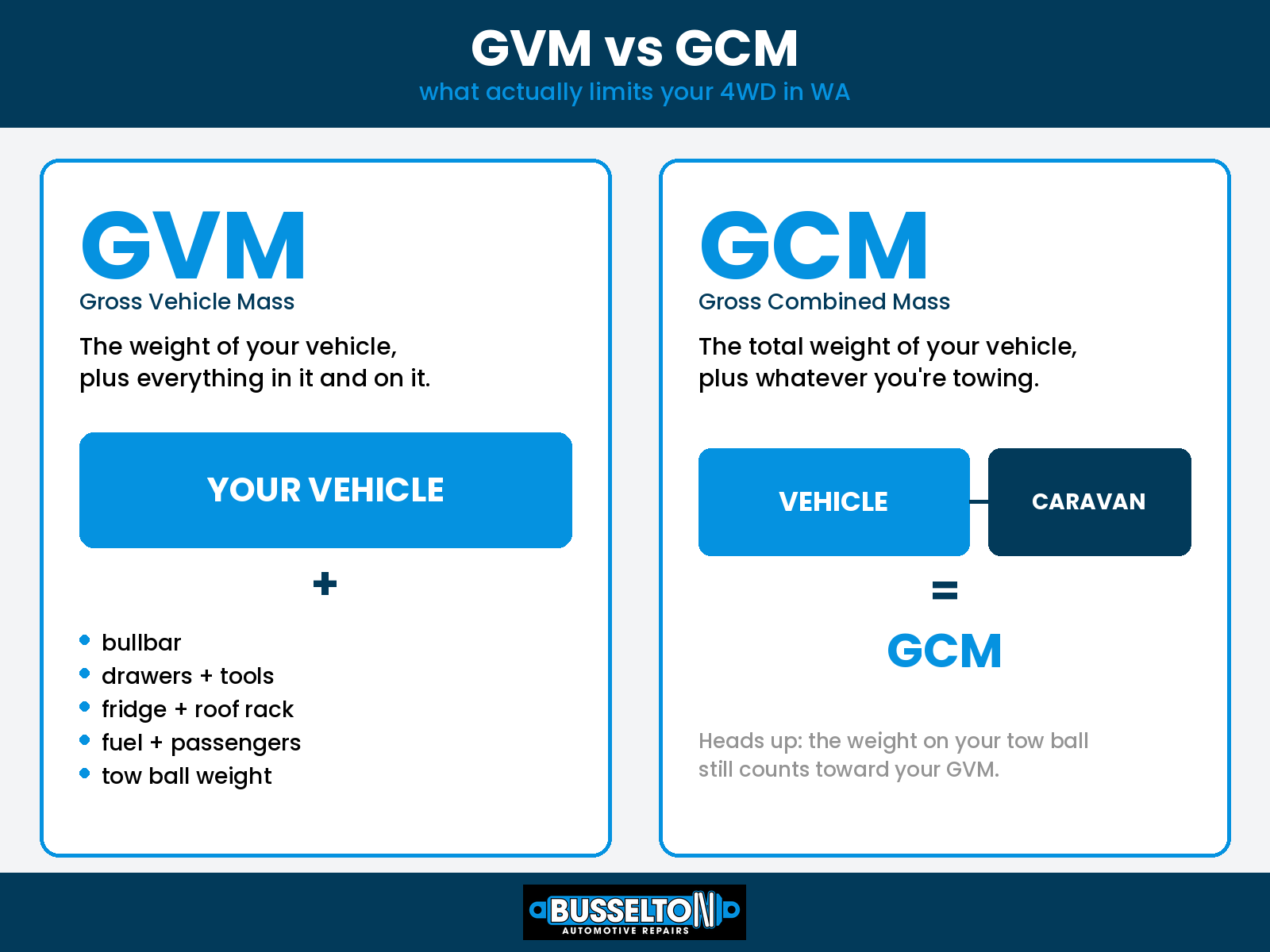
GVM (Gross Vehicle Mass) is the weight of your vehicle, plus anything you add to it.
So that includes your tow bar, your bullbar, your drawers, your roof rack, your tools, your fridge, your passengers — and whatever you've got hooked up to your tow ball.
If it's attached to the vehicle or sitting in it, it counts.
What is GCM?
GCM (Gross Combined Mass) is the total combined weight of your vehicle plus whatever you're towing.
So if your loaded ute weighs 3,500kg and the loaded caravan behind it weighs 3,000kg, your combined weight is 6,500kg. That number has to come in under your vehicle's GCM rating.
Don't forget the tow ball
This is the one that catches people out. Your tow ball download counts toward your GVM.
A caravan usually puts about 10% of its weight onto the tow ball. So if your caravan weighs 3,000kg, that's around 300kg added to your vehicle before you've even climbed in.
A lot of people don't factor that in until it's too late.
New suspension isn't a GVM upgrade
We hear this one a fair bit. "I've just put new shocks under it, so I've got more capacity, right?"
Not quite. Better suspension can absolutely improve how your vehicle handles a load. But a legal GVM upgrade has to be approved by an engineer. That's why it's sold as a kit and sighted by the installer to confirm it's correct and legal.
If it isn't engineer-approved, your GVM hasn't gone up — just your ride quality has.
What about GCM upgrades in WA?
For a long time, you couldn't legally increase your GCM in WA once your vehicle was registered.
The rules around that have started to shift recently, but the options are still very limited and depend on what you drive. For most vehicles, the GCM you've got from factory is still the GCM you're working with.
If you're not sure where you sit, or you're weighing up a bigger van, come and have a chat. We can talk through what your vehicle is rated to, what's realistic for your towing plans, and what your options actually are before you commit to anything.
If you're shopping for a tow vehicle and your towing plans are big, GCM is still the number to look at before you buy — not after.
Why all of this matters
Two reasons. Safety and insurance.
An overloaded vehicle handles differently, brakes differently, and puts a lot more stress on your driveline, tyres and suspension. None of that is what you want when you're heading down south with the family and the van in tow.
The other one is insurance. If you're in an accident and you're over your weight limit, there's a real chance your insurance won't cover you. That's a heavy price to pay for a number most people never bothered to check.
Not sure where your setup sits?
We've got a short calculator on our website that'll give you a starting point. From there, the most accurate next step is to take your vehicle to a weighbridge — loaded exactly how you travel. Caravan on, full fuel, passengers, fridge, the lot.
Bring the numbers back to us and we'll work out where you sit and whether a GVM upgrade is the right call.